contract wins
Siemens takes on five-year servicing of 1,000 First Bus chargers across the UK
The agreement moves the relationship from charger supply to a nationwide maintenance contract, covering remote monitoring, preventative work, site call-outs, repairs and parts for a fleet of more than 1,500 zero-emission buses.
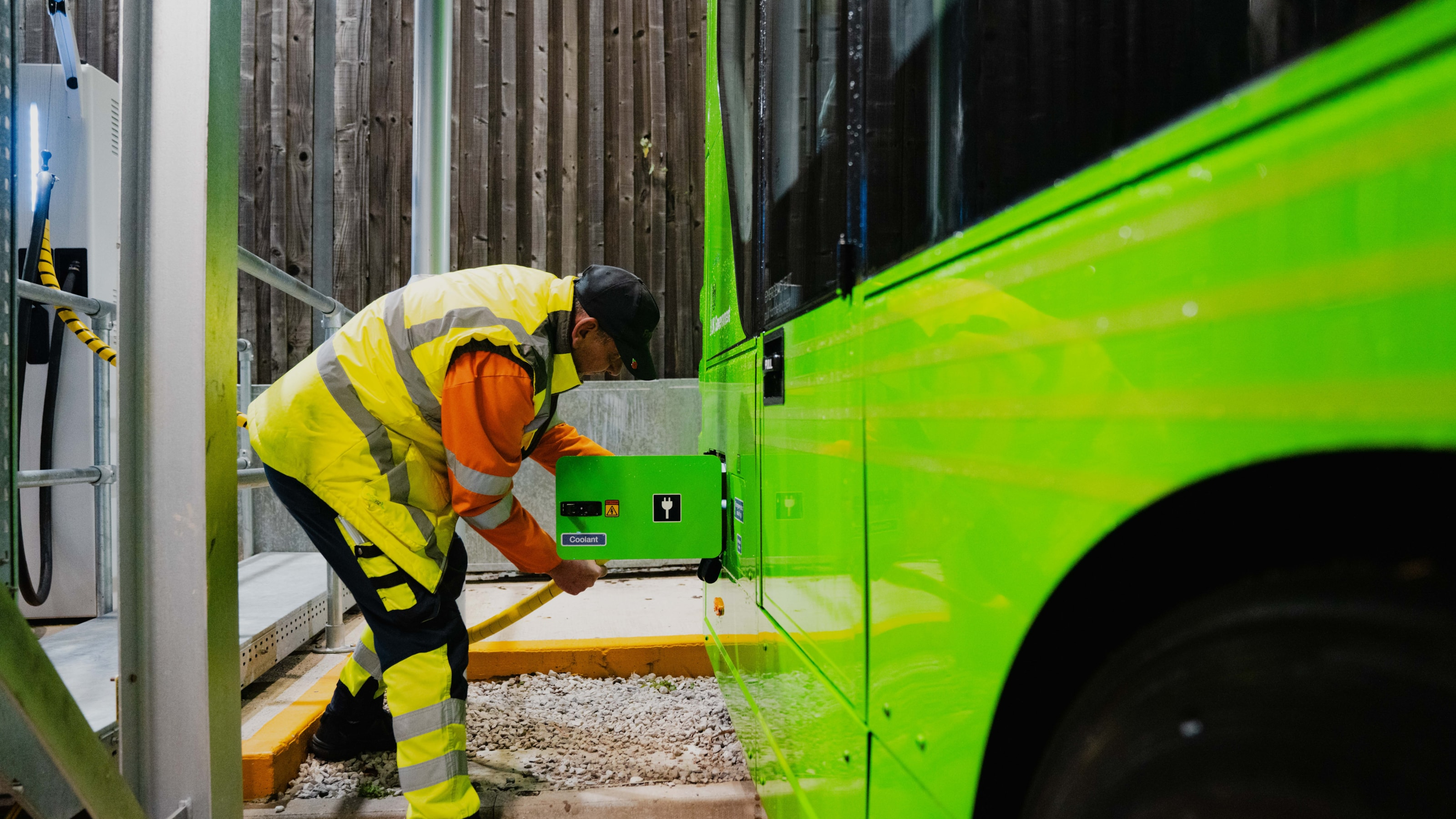
Siemens has signed a five-year agreement with First Bus to maintain and service 1,000 DC charge points across the UK, the operator's depot charging network for a fleet of more than 1,500 zero-emission buses.
Siemens announced the deal on 23 November. The body of its release puts the number of chargers at 1,000, while its summary describes the agreement as covering approximately 1,000.
The services run from 24/7 remote support and proactive system monitoring through to preventative maintenance, on-site intervention, repairs and replacement parts, Siemens said. The company said the package is designed to maximise charger availability and reduce operational risk for the operator.
David Seaton, Director of Infrastructure at First Bus, said: "Reliable charging infrastructure is critical to our growing zero-emission bus network."
First Bus's zero-emission buses make up more than a quarter of its entire fleet, according to Siemens. The operator has committed to running a fully zero-emission commercial bus fleet by 2035.
From hardware to service
Stephen Wood, Head of Siemens eMobility UK, said: "This agreement reflects the strong partnership Siemens and First Bus have built over the last five years."
That partnership began, Siemens said, with the electrification of the Caledonia depot in Glasgow in 2021. The charging system there was supplied by Heliox, the Dutch charger maker, according to a First Bus announcement of June 2021 quoting Michael Colijn, Chief Executive Officer at Heliox Group.
Siemens AG completed its acquisition of Heliox in January 2024. Heliox is headquartered in the Netherlands, employs about 330 people and offers charging from 40kW up to megawatt systems for depots and en-route charging, Siemens said at the time. Siemens eMobility sits within Siemens Smart Infrastructure.
In October 2024, Heliox, A Siemens Business, announced it would electrify five further First Bus depots at Bristol, Weston-super-Mare, Minehead, Taunton and Basildon. Heliox said the five sites were backed by an £89m investment from First Bus and a £16m grant from the UK Government's ZEBRA 2 scheme, and would have the combined capacity to charge more than 190 vehicles at the same time. Wood was Heliox Country Manager UK & Ireland at that point.
Caledonia depot
Caledonia, in Glasgow's southside, is where Siemens says the partnership began. First Bus announced the start of work there on 7 June 2021, committing a further £35.6m to the depot's transition. Phase one involved 11 dual DC rapid charging units, with a further 69 dual-headed units planned for phase two, and the depot was designed with space to charge up to 300 electric buses.
First Bus marked completion of the hub on 27 May 2022, saying 160 rapid charging points had been installed over nine months and that 150 electric buses could be charged at one time. Jenny Gilruth, Scottish Minister for Transport, said at the time that the hub was made possible by £26.3m of Scottish Government investment.
The numbers have since moved. Siemens now says the depot has more than 170 charging points. In September 2026 First Bus said its energy management project at Caledonia had scaled from 34 to 172 charging outlets, and that the depot has a potential 12MW charging load operating within a 5MW grid connection.
Siemens said the services under the new agreement would support the reliable operation of First Bus's growing zero-emission fleet. The service contract runs for five years.
Sources
- Siemens (opens in a new tab) (accessed 2026-11-23)
- Siemens AG (opens in a new tab) (accessed 2026-11-23)
- Heliox, A Siemens Business (opens in a new tab) (accessed 2026-11-23)
- First Bus (opens in a new tab) (accessed 2026-11-23)
- First Bus (opens in a new tab) (accessed 2026-11-23)
- First Bus (opens in a new tab) (accessed 2026-11-23)
This story was researched from the primary sources above and checked against them before publication. Spotted an error? Tell us and we will correct it promptly.