standards
ECA urges members to comment on draft fourth edition of IET energy storage code
The Electrical Contractors' Association has asked members to respond to the IET's draft fourth edition of its Code of Practice for Electrical Energy Storage Systems before the 9am deadline on 16 November 2026.
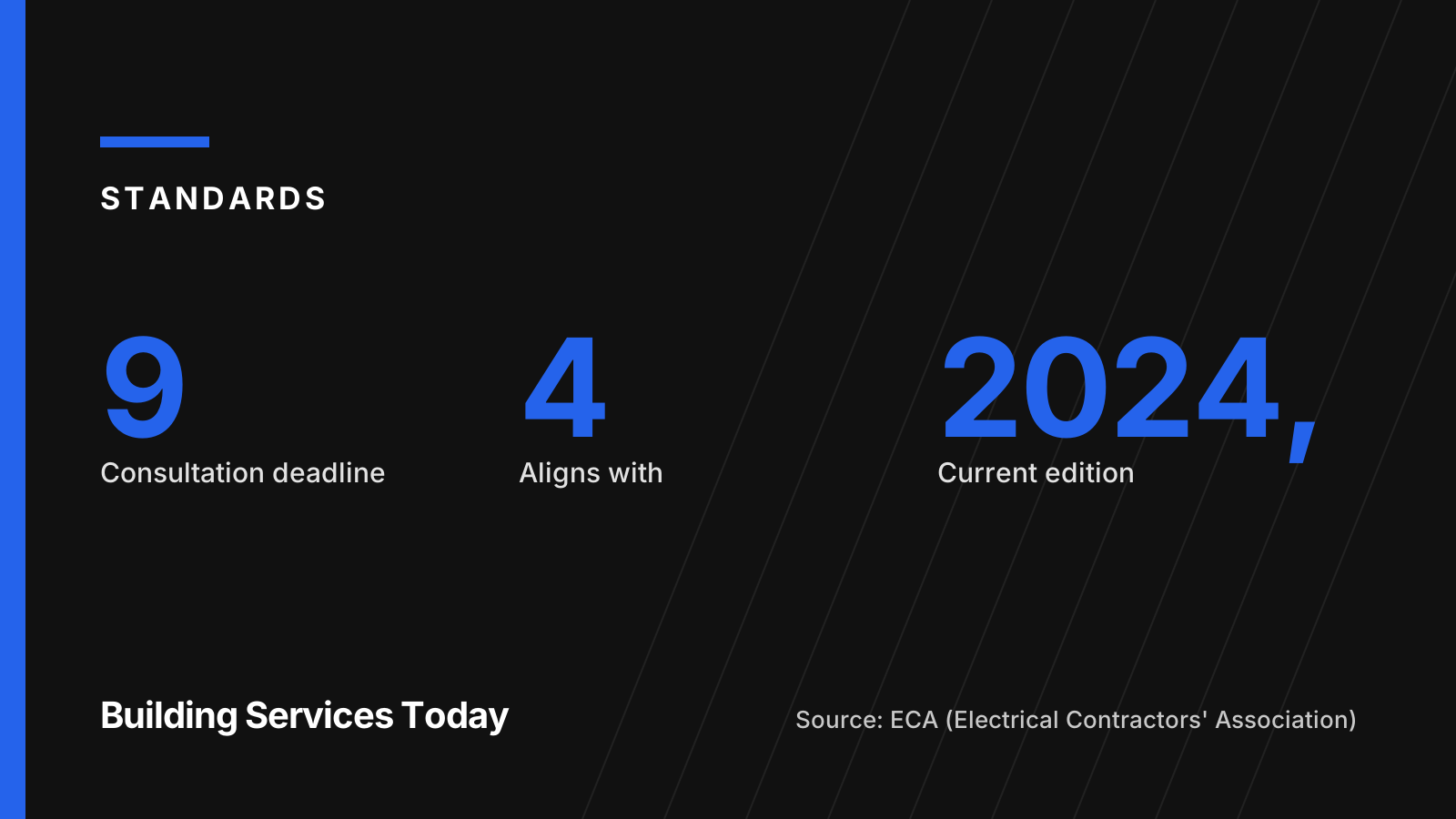
The Electrical Contractors' Association (ECA) has asked its members to comment on the draft fourth edition of the Institution of Engineering and Technology (IET) Code of Practice for Electrical Energy Storage Systems before 9am on Monday 16 November 2026.
ECA said the draft covers a range of proposed updates, from sodium-ion batteries to islanding equipment, to reflect developments in the electrical energy storage market and to align the code with Amendment 4 of BS 7671, the IET Wiring Regulations.
The IET, which is running the consultation, said the fourth edition is intended to bring the code up to date with the latest developments. The code sets out information for practitioners to specify, design, install, commission, operate and maintain an electrical energy storage system (EESS).
What is proposed
According to ECA, the proposed changes include new guidance on islanding equipment, expanded battery technology coverage including sodium-ion batteries, and new guidance for values of consumer earth electrode resistance.
The draft also carries enhanced guidance on arc flash, fire safety, residual current device (RCD) selection, earthing, signage and certification, together with updated references to other related standards, ECA said.
The IET said the code's scope covers EESS for individual dwellings, commercial applications including multi-occupancy buildings, and industrial applications. The code addresses electrochemical energy storage systems in electrical installations and their integration into low voltage AC and DC power systems.
How to respond
ECA said comments should go directly to the IET, using the IET's preferred comment form and following its guidance, rather than to the trade body. The IET does not permit direct links to the draft documents to be shared, and readers must register with the institution to download them.
The IET said it issues a draft for public consultation (DPC) for each of its codes and guidance titles so that readers can feed back on the content, with the aim of ensuring its publications reflect the needs of the industry.
ECA, which describes a DPC as an early version of a document shared with the public, said it encourages all members to take part in public consultations and drafts for public comment.
Why the code is changing
The revision follows the publication of Amendment 4 to BS 7671:2018 by the IET and BSI on 15 April 2026. The IET said the amendment introduced a new chapter covering stationary secondary batteries, and that the previous version of the standard, BS 7671:2018+A2:2022+A3:2024, would be withdrawn six months from that date.
Mark Coles, Head of Technical Regulations at the IET, said at the time of publication: "The IET is the UK's authority for electrical installations".
The current third edition of the energy storage code was published in 2024 and runs to 192 pages. According to the IET, that edition added an update to the requirements for island mode isolators and further guidance on fire safety and the location of batteries within an installation.
ECA, founded in 1901, describes itself as the UK's leading trade association for the electrotechnical and wider engineering services industry.
The consultation closes at 9am on Monday 16 November 2026.
On the record: BSI
Sources
- ECA (Electrical Contractors' Association) (opens in a new tab) (accessed 2026-10-22)
- ECA (Electrical Contractors' Association) (opens in a new tab) (accessed 2026-10-22)
- Institution of Engineering and Technology (IET) (opens in a new tab) (accessed 2026-10-22)
- Institution of Engineering and Technology (IET) (opens in a new tab) (accessed 2026-10-22)
- Institution of Engineering and Technology (IET) (opens in a new tab) (accessed 2026-10-22)
- Institution of Engineering and Technology (IET) (opens in a new tab) (accessed 2026-10-22)
- ECA (Electrical Contractors' Association) (opens in a new tab) (accessed 2026-10-22)
This story was researched from the primary sources above and checked against them before publication. Spotted an error? Tell us and we will correct it promptly.