standards
CIBSE publishes TM59 (2026) but 2017 edition still rules for Part O compliance
The institution's revised overheating methodology adds a sleeping-hours bedroom criterion, 2050s weather files and an unconstrained test, while it is in discussion with the Building Safety Regulator about updating the Approved Documents.
The Chartered Institution of Building Services Engineers (CIBSE) has published a revised edition of TM59, its design-stage methodology for assessing overheating risk in dwellings, while confirming that the 2017 version remains the document required for Part O compliance.
The 39-page TM59 (2026), dated July 2026 on the CIBSE Knowledge Portal, is free to download at both standard and member rates. CIBSE said it recommends using the new edition to align with industry best practice, while the 2017 edition remains required for Part O compliance.
The institution said it is in discussion with the Building Safety Regulator (BSR) about how its updated weather files and the latest TM59 can be incorporated into the Approved Documents.
Ahmed Hegazi, Head of Knowledge and Digital at CIBSE, said: "Overheating is no longer a future risk – it's a present reality for households across the UK".
What has changed
CIBSE said the key changes are a new bedroom overheating criterion, backed by recent Loughborough University research, and updated ceiling fan modelling, which the institution described as an effective low-energy measure for improving occupant comfort.
Professor Kevin Lomas of Loughborough University, the document's executive editor, said the new criterion "defines overheating in bedrooms when people are sleeping". He also said UK dwellings, including in London, can be designed to stay comfortable using purely passive measures up to the 2050s.
The 2026 edition requires all homes to be tested under unconstrained conditions using weather files representing the 2050s climate. CIBSE said this places the emphasis on passive design from the outset, so homes can hold summer comfort without relying on active cooling.
The methodology sets out a three-stage overheating assessment strategy using dynamic thermal models. It covers houses, apartments, sheltered accommodation, care homes, student accommodation, prisons and bedrooms in hotels and hospitals. CIBSE said the revision draws on a decade of real-world use of the methodology.
Who wrote it
Susie Diamond of Inkling is lead author, with Becci Taylor and Antonietta Canta of Arup as co-authors. Peer reviewers were Ben Abel of Hilson Moran, Anna Mavrogianni of UCL, Marguerita Chorafa of Introba and Jack Harvie-Clark of Apex Acoustics Ltd.
Practitioners from firms including Arup, Atkins, Buro Happold, Etude, Hilson Moran, IES, Introba, Max Fordham and Mott MacDonald tested the methodology on live projects, according to the acknowledgements. Loughborough University said in its own release that the revision incorporates recent research, some of which CIBSE funded.
Taylor, Director and UK Housing Property Lead at Arup, said that when TM59 was first developed there was no consistent way to assess overheating risk in homes. Canta, an Associate at Arup, said the update reflects growing understanding of how buildings perform in a warming climate.
The regulatory position
Government guidance on Approved Document O says the building control body should receive a report demonstrating that a building passes CIBSE's TM59 assessment, containing the details set out in TM59 section 2.3. The same guidance notes that SAP does not calculate the cooling loads found through the dynamic thermal modelling method.
That leaves engineers working to two editions: the 2017 document for the compliance report, and the 2026 edition CIBSE now recommends as best practice.
On 26 March 2026 CIBSE welcomed the government's announcement of a review of Part O and how regulations can further align with TM59, published alongside the Future Homes and Buildings Standards changes and the government's response to a call for evidence on Approved Document O.
Separately, CIBSE released its latest weather data set on 14 July 2025, covering 28 climate zones across the UK and moving the observed baseline from 1984-2013 to 1994-2023. The institution said at the time that the new datasets were not required for regulatory compliance at launch.
The wider risk
CIBSE's overview of the new edition says the Climate Change Committee (CCC) in 2026 placed risks to buildings and communities from heat in its highest risk category, which CIBSE describes as "Critical Action needed".
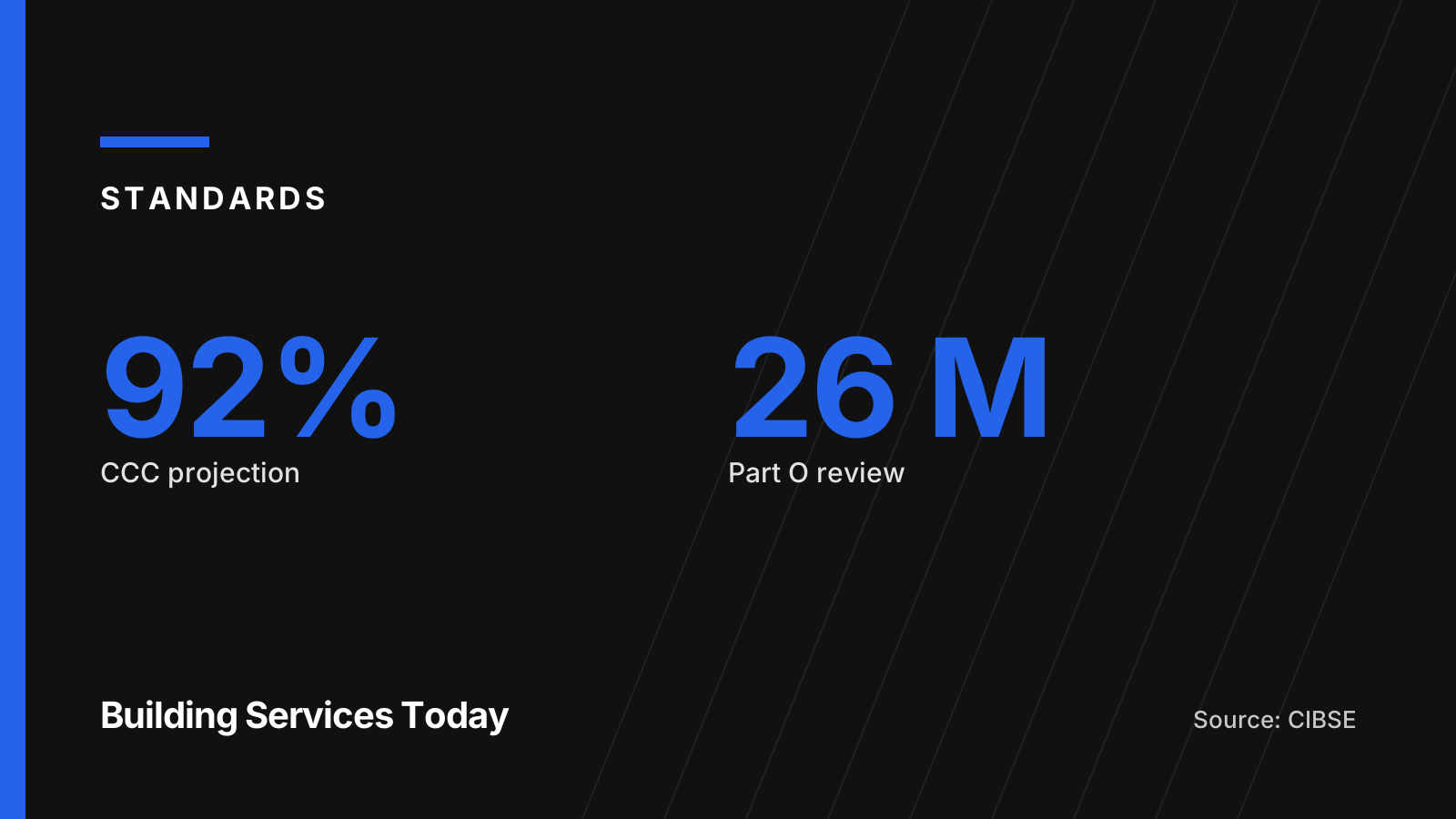
The CCC said on 20 May 2026 that by 2050, 92% of homes are likely to overheat, and that its adaptation proposals require investment of about £11bn a year. CIBSE's overheating position statement says overheating in buildings is expected to cause about 4,500 premature deaths a year by 2050 if not addressed.
CIBSE is running a #GrowYourKnowledge session on what has changed in TM59 and why.
On the record: CIBSE, Arup, Buro Happold, Max Fordham, Mott MacDonald, Ministry of Housing, Communities and Local Government
Sources
- CIBSE (opens in a new tab) (accessed 2026-10-23)
- CIBSE (opens in a new tab) (accessed 2026-10-23)
- Loughborough University (opens in a new tab) (accessed 2026-10-23)
- Climate Change Committee (opens in a new tab) (accessed 2026-10-23)
- GOV.UK (Ministry of Housing, Communities and Local Government) (opens in a new tab) (accessed 2026-10-23)
- CIBSE (opens in a new tab) (accessed 2026-10-23)
- CIBSE (opens in a new tab) (accessed 2026-10-23)
- CIBSE (opens in a new tab) (accessed 2026-10-23)
This story was researched from the primary sources above and checked against them before publication. Spotted an error? Tell us and we will correct it promptly.