standards
CIBSE urges Heat Risk Commission to close gap between overheating tools and Part O
The building services body has told the National Heat Risk Commission that Building Regulations compliance still rests on 2016 weather files, despite its own TM59:2026 and 2025 Weather Data testing homes against 2050s conditions.
The Chartered Institution of Building Services Engineers (CIBSE) has told the National Heat Risk Commission that overheating regulation lags behind its own design tools and must not wait for a 2029 Building Regulations freeze to lift.
In a submission to the Commission's call for evidence, published on 3 November, CIBSE said compliance with Building Regulations still relies on 2016 weather files, while its 2025 Weather Data and updated TM59 dwelling methodology now assess homes against the 2050s climate.
The response, submitted by Sam Baptist, CIBSE's Director of Policy & External Affairs, argues that extreme heat is largely a building performance problem. It calls for updated building regulations and design guidance, overheating assessments for existing buildings and major refurbishment, thermal safety expectations for critical public buildings and a national heat resilience strategy.
Ahmed Hegazi, Head of Knowledge and Digital at CIBSE, said when the institution launched TM59:2026 in July: "Overheating is no longer a future risk – it's a present reality for households across the UK".
The regulatory gap
CIBSE said its standards, including Guide A, TM52, TM59 and its Weather Data, underpin Approved Document O in England and the Department for Education's Building Bulletin 101 for schools. Approved Document O, first published on 15 December 2021, sets overheating standards for new residential buildings in England, according to the Ministry of Housing, Communities and Local Government.
CIBSE launched the updated TM59 on 6 July 2026 with Arup, Loughborough University and Inkling. Under TM59:2026, all homes must be assessed under unconstrained conditions using future weather files representing the 2050s climate. CIBSE's own guidance page notes, however, that TM59 (2017) is still required for compliance with Part O, and that the 2016 weather data sets remain required for Part L and Part O.
The 2025 Weather Data adds UK Climate Projections 2018 (UKCP18) projections for the 2030s, 2050s and 2080s, expands coverage from 16 locations to 28 climate zones and uses historical observations from 1994 to 2023, CIBSE said.
CIBSE said the government has committed to a technical review of Approved Document O, including adoption of the updated TM59, but no timetable has been published. It said it is discussing with the Building Safety Regulator how the updated weather files and TM59 can be incorporated into Approved Documents.
The submission's executive summary says the Chancellor's recent announcement that Building Regulations will not be changed until 2029 must not prevent amendments to mitigate overheating risk. Elsewhere in the same document, CIBSE says the 28 October 2026 Budget confirmed that no major changes would be made to Building Regulations.
CIBSE also said building regulations do not require an overheating assessment for major changes to existing homes or for other building types.
What CIBSE is asking for
Beyond regulation, the institution wants a thermal safety standard for hospitals, care homes, schools and prisons, with indoor temperature monitoring and mitigation plans. It calls for a passive-first cooling hierarchy supported by efficient low-carbon cooling, and minimum competence expectations on overheating and climate resilience for designers, modellers and retrofit professionals.
It asks government and funders to require overheating risk assessment in publicly funded retrofit programmes, warning that retrofit without such assessment can raise summer temperatures and that reliance on mechanical cooling shifts costs to those least able to pay. Strategies that depend on occupants opening windows often fail in practice because of noise, security and air quality, it said.
CIBSE asks the Building Safety Regulator and building control bodies to ensure overheating assessments are reviewed competently at approval, and the Met Office and UK Health Security Agency (UKHSA) to keep investing in climate projections and data linking indoor temperatures to health outcomes.
Its stated ambition is that by 2036 every new home and major refurbishment is designed and verified to stay safe and comfortable in the 2050s climate.
The health figures
CIBSE cites Climate Change Committee figures from 2022 that around one in five homes already overheats in summer and around 90% could do so under 2°C of global warming.
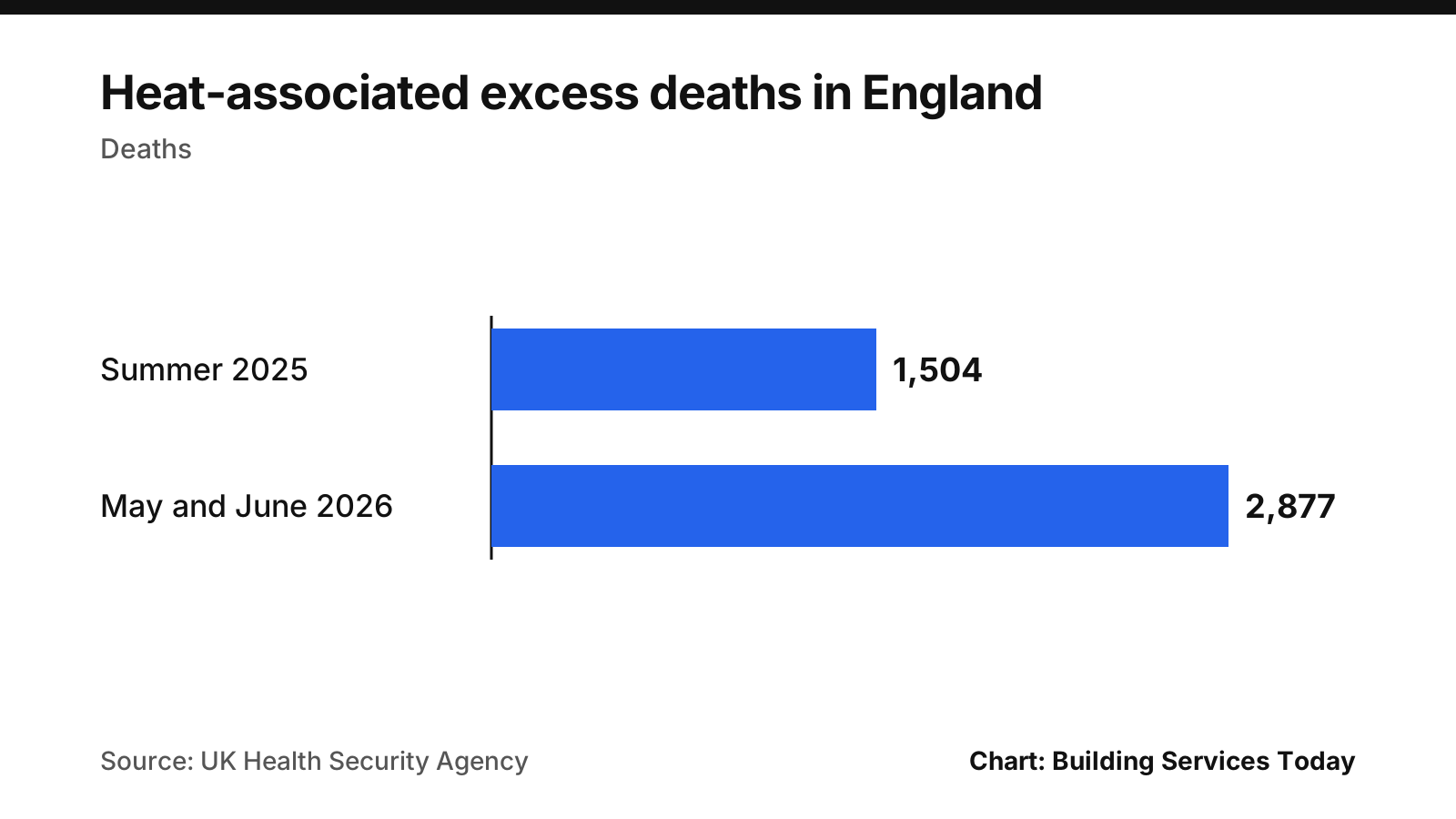
Its submission refers to UKHSA reporting over 2,800 heat-related deaths in England during the May and June heatwaves. UKHSA's own release puts the estimate at 2,877 heat-associated deaths across two hot weather periods: 753 linked to the 24 to 27 May episode and 2,124 to June, when an eight-day heatwave triggered a red heat-health alert. UKHSA said this was a significant increase on the 1,504 excess deaths observed in summer 2025.
| Period | Heat-associated excess deaths (UKHSA) |
|---|---|
| Summer 2025 | 1,504 |
| May and June 2026 | 2,877 |
The Commission's timetable
The National Heat Risk Commission, hosted by the Grantham Research Institute at the London School of Economics, published its framing report, A Heat Circuit Breaker for the UK, on 3 September 2026. It said heat risk has been catalogued for more than a decade, yet action to address it has been slow.
Emma Howard Boyd CBE, Chair of the National Heat Risk Commission, said: "Heatwaves will become hotter, more deadly and more disruptive. Our task is to ensure that the UK is better prepared when they strike."
The first phase of the call for evidence sought submissions from organisations across the UK by 30 October 2026. Future phases will include hearing directly from individuals, the Commission said.
CIBSE said it would welcome the opportunity to work with the Commission as its programme develops. The Commission's report, which may quote from submitted evidence, is due to be published in summer 2027.
On the record: CIBSE, Ministry of Housing, Communities and Local Government, Arup, Met Office
Sources
- CIBSE (opens in a new tab) (accessed 2026-11-03)
- Grantham Research Institute, LSE (National Heat Risk Commission) (opens in a new tab) (accessed 2026-11-03)
- Grantham Research Institute, LSE (National Heat Risk Commission) (opens in a new tab) (accessed 2026-11-03)
- CIBSE (opens in a new tab) (accessed 2026-11-03)
- CIBSE (opens in a new tab) (accessed 2026-11-03)
- CIBSE (opens in a new tab) (accessed 2026-11-03)
- UK Health Security Agency (GOV.UK) (opens in a new tab) (accessed 2026-11-03)
- Ministry of Housing, Communities and Local Government (GOV.UK) (opens in a new tab) (accessed 2026-11-03)
This story was researched from the primary sources above and checked against them before publication. Spotted an error? Tell us and we will correct it promptly.