standards
BESA survey finds 74% of firms see no significant change in client behaviour under Building Safety Act
The trade body's third annual survey shows awareness of the Act is widespread among contractors, but respondents report frustration with clients, commercial pressure and gaps in historic project records.
The Building Engineering Services Association (BESA) has published its third annual survey on the Building Safety Act, finding that 74% of respondents have seen no significant change in client behaviour since the legislation came into force.
The research, released on 19 October, contacted more than 6,000 firms. BESA said awareness of the Act is now widespread, with 64% of respondents confident they could demonstrate their duty holder requirements "very well".
Rachel Davidson, BESA's director of specialist knowledge, said: "Four years after the Act came into force, more firms are building the knowledge and behaviours needed for a safer built environment."
She added: "However, there is a level of frustration about information overload, commercial pressures and clients who are 'not on the same page'. And there are still firms that are not engaging with the process at any level, but their ranks are shrinking."
Client behaviour
According to BESA, contractors and specialists are adapting their systems and processes, but some respondents questioned whether clients' procurement practices and understanding of their own responsibilities were changing at the same pace. One respondent told the survey that resisting client pressure led to conflict and that firms were commercially punished for doing the job properly.
BESA's Client's Guide to the Building Safety Act, published earlier in 2026 with support from cross-industry partners, states that clients are now statutory dutyholders. The guide covers what changes for higher-risk buildings, including the Gateway process.
Smaller firms and competence
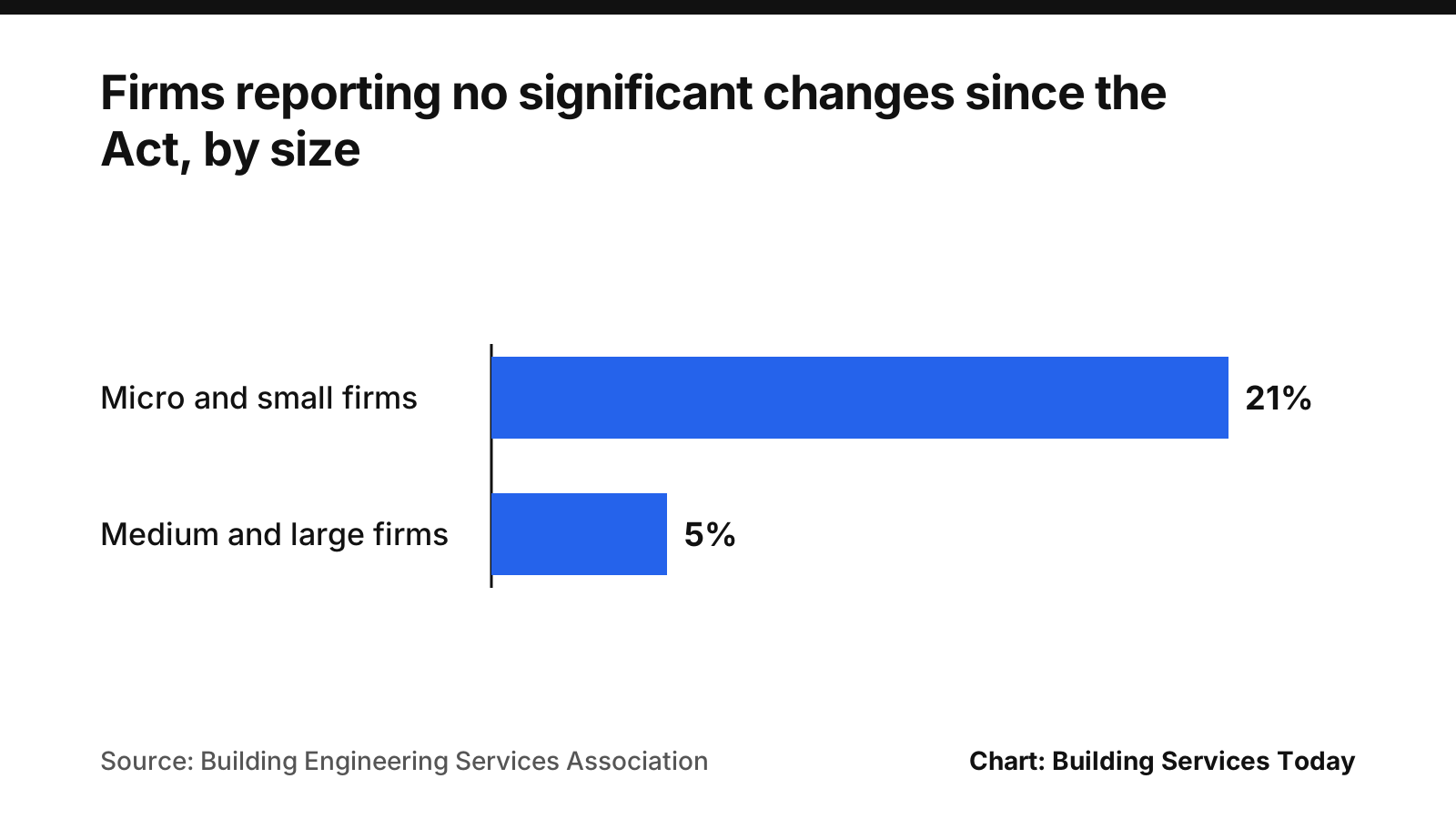
The survey found that smaller businesses are adapting more slowly than larger ones. BESA said 21% of micro and small organisations had made no significant changes, against 5% of medium and large organisations.
| Firm size | No significant changes made |
|---|---|
| Micro and small organisations | 21% |
| Medium and large organisations | 5% |
Competence remains a difficulty. BESA's report landing page puts the proportion of respondents struggling to demonstrate competence in practice at 36%, and 40% said competence issues were identified "frequently or occasionally". About one in three reported challenges in demonstrating assurance across the supply chain they appoint.
Historic compliance was described by some respondents as a "ticking time bomb". Only 30% said they were confident they could provide evidence of competence and compliance for projects carried out more than 10 years ago. The report lists maintaining accessible, traceable project records as one of its themes.
Background
BESA launched the 2026 survey on 11 June with support from Barbour ABI, asking MEP professionals how the legislation was affecting day-to-day operations, management systems and workforce competence. The Building Safety Regulator's Industry Competence Committee helped shape questions on future competence requirements and policy.
The 2025 survey, the second BESA had run, was distributed to more than 20,000 businesses. That report found overall awareness of the Act was high but identified lack of clarity, cost and resource pressures as barriers to progress. In July 2025 BESA said awareness and understanding had improved over the previous 12 months.
In April 2026 the association published a free guide, Demonstrating Competence under the Building Safety Act, which sets out a pathway for employers to meet the legislation's competence requirements. BESA defines competence using the principles of Skills, Knowledge, Experience and Behaviours, known as SKEB. Davidson said at the time that employers had always been liable for ensuring the right competence was in the right roles at the right time.
The Building Safety Act received Royal Assent on 28 April 2022, according to the Ministry of Housing, Communities and Local Government.
Davidson said BESA was now moving from raising awareness to helping firms meet the assurance challenge of demonstrating competence and compliance in practice. The Building Safety Act Industry Report 2026 is available to download free of charge from BESA.
On the record: Building Engineering Services Association, Ministry of Housing, Communities and Local Government
Sources
- Building Engineering Services Association (BESA) (opens in a new tab) (accessed 2026-10-19)
- Building Engineering Services Association (BESA) (opens in a new tab) (accessed 2026-10-19)
- Building Engineering Services Association (BESA) (opens in a new tab) (accessed 2026-10-19)
- Building Engineering Services Association (BESA) (opens in a new tab) (accessed 2026-10-19)
- Building Engineering Services Association (BESA) (opens in a new tab) (accessed 2026-10-19)
- Building Engineering Services Association (BESA) (opens in a new tab) (accessed 2026-10-19)
- Building Engineering Services Association (BESA) (opens in a new tab) (accessed 2026-10-19)
- GOV.UK (Ministry of Housing, Communities and Local Government) (opens in a new tab) (accessed 2026-10-19)
This story was researched from the primary sources above and checked against them before publication. Spotted an error? Tell us and we will correct it promptly.